
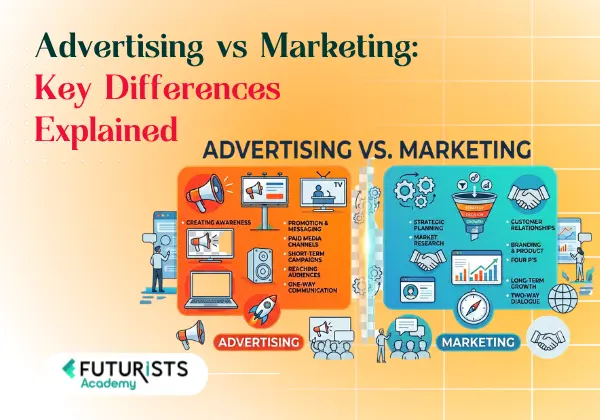
Ask ten people what the difference is between Advertising vs Marketing and you will get ten confident, contradictory answers. Some will say they are the same thing. Some will say marketing is online and advertising is offline. Others will point at a hoarding on G.S. Road and call it marketing.
None of those are quite right — and the confusion is expensive. Business owners spend money on ads while skipping the strategy that would make those ads work. Students apply for jobs without understanding which one they are actually being hired to do. So let us settle it properly.
What is Marketing?
Marketing is everything a business does to identify what people want, build something that satisfies that want, and get it into their hands at a price they will pay. It begins long before a single rupee is spent on promotion and continues long after the sale.
The classic way to describe this scope is the marketing mix — the 4Ps, a framework popularised by E. Jerome McCarthy in 1960 and still the standard teaching model:
- Product — what you are actually selling, including features, quality, packaging and after-sales support.
- Price — what you charge, how you discount, and what your pricing signals about quality.
- Place — where and how customers can buy: your shop, your website, a marketplace, a distributor network.
- Promotion — how you communicate value. This is where advertising lives, alongside PR, content, SEO and sales.
Service businesses often extend this to 7Ps by adding People, Process and Physical Evidence — which matters for anyone marketing a coaching institute, a clinic, a hotel or a consultancy, where the experience itself is the product. Notice that three of the four Ps have nothing to do with promotion at all. That is the single most useful thing to understand about marketing: most of it is invisible to the customer
What is Advertising?
Advertising is paid, controlled, non-personal communication that promotes a product, service, brand or idea to a defined audience through a chosen medium.
Three words in that definition do the heavy lifting:
- Paid — you are buying access to someone else’s audience. A newspaper’s readers, a channel’s viewers, Google’s search results, an influencer’s followers. If it is free coverage, it is public relations, not advertising.
- Controlled — you decide the message, the visuals, the timing and the placement. This is the key difference from PR, where a journalist decides how your story is told.
- Non-personal — the message goes to many people at once rather than being tailored in a one-to-one conversation. That is what separates advertising from direct selling.
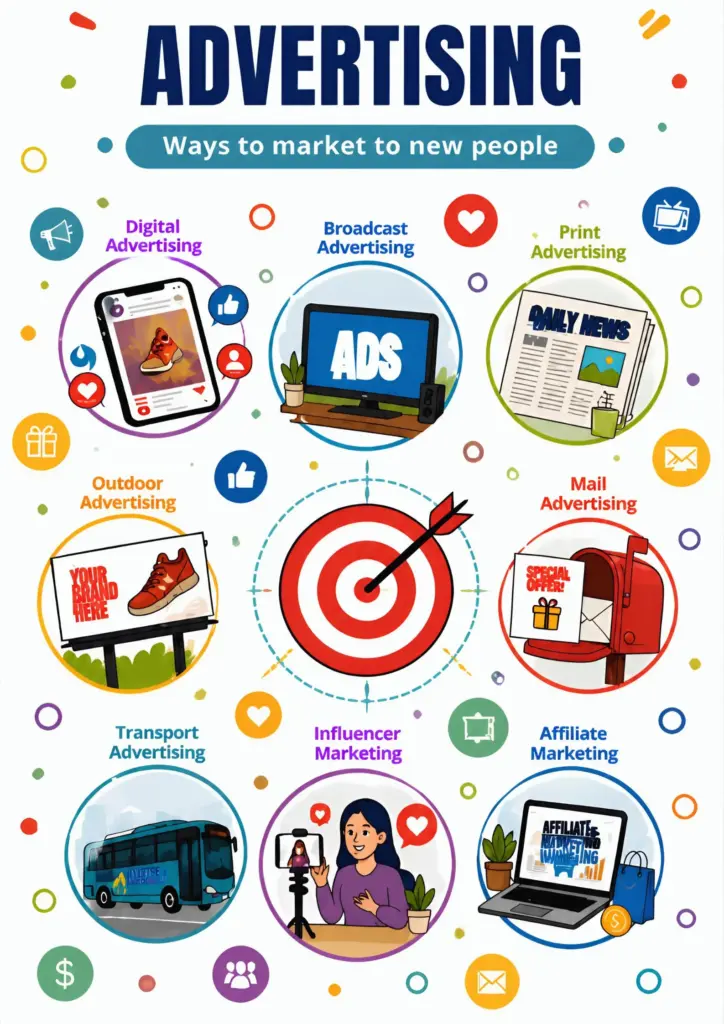
So a Google Search ad, a Facebook video ad, a hoarding at Zoo Road, a radio jingle, and a sponsored Instagram Reel are all advertising. A blog post you wrote and ranked yourself is not — that is content marketing and SEO. A customer recommending you to a cousin is not — that is word of mouth.
Advertising vs Marketing: The Difference at a Glance
This table is the fastest way to hold both concepts in your head at once.
| Parameter | Marketing | Advertising |
| Scope | The whole process — research, product, pricing, distribution, promotion | One promotional activity within that process |
| Relationship | The parent discipline | A subset of marketing |
| Core question | Who is our customer and what value can we create for them? | How do we place our message in front of them? |
| Time horizon | Long term — builds brand equity and customer relationships | Usually campaign-based — runs for a defined period |
| Cost | Includes unpaid effort: SEO, organic social, research, referrals | Always paid — media space or time is purchased |
| Control of message | Partial — reviews, PR and word of mouth are shaped, not controlled | Full — you write, design and place the message |
| Direction | Two-way — listens to the market and feeds insight back | Largely one-way — broadcasts a message outward |
| Primary goal | Sustainable demand, loyalty and market position | Reach, recall, response and conversions |
| Measured By | Market share, customer lifetime value, retention, brand health | Impressions, CTR, cost per click, cost per acquisition, ROAS |
| Skills Needed | Strategy, research, analytics, pricing, positioning, communication | Copywriting, design, media buying, campaign optimisation |
| Everyday Example | Deciding to launch a weekend batch for working professionals at a specific fee | Running an Instagram campaign announcing that weekend batch |
How Advertising and Marketing Fit Together
The cleanest mental model is nested circles. Marketing is the outer circle. Inside it sits promotion, one of the 4Ps. Inside promotion sits advertising, next to public relations, content marketing, SEO, email, events and personal selling.
A simpler analogy: marketing is the entire kitchen — sourcing ingredients, deciding the menu, setting prices, plating. Advertising is the aroma you let drift into the street to bring people in. The aroma is powerful. It also cannot save a bad dish.
Various Types of Marketing
Marketing is usually split by channel and by approach. These categories overlap in practice; most businesses run several at once.
Digital Marketing
- Search engine optimisation (SEO) — earning visibility in unpaid search results through technical health, content and authority.
- Content marketing — blogs, guides, videos and newsletters that attract an audience by being useful rather than promotional.
- Social media marketing — building presence and community on Instagram, YouTube, LinkedIn, Facebook and emerging platforms.
- Email and WhatsApp marketing — owned channels that reach an audience directly without paying a platform for access each time.
- Influencer and creator marketing — working with people who already hold an audience’s trust.
- Affiliate marketing — paying partners a commission only on results they generate.
- Performance marketing — the umbrella for measurable, conversion-accountable channels, most of which are paid.
Traditional and Offline Marketing
- Print and broadcast — newspaper, magazine, radio and television presence.
- Event and experiential marketing — trade fairs, campus drives, workshops, sponsorships, demo days.
- Direct marketing — catalogues, direct mail, telecalling and SMS aimed at a specific contact list.
- Point-of-sale and retail marketing — in-store display, shelf placement, packaging and merchandising.
Strategy-led approaches
- Inbound Marketing — pulling customers in with useful content instead of interrupting them.
- Outbound Marketing — proactively reaching out through cold calls, cold email and broadcast advertising.
- Relationship Marketing — optimising for retention and lifetime value rather than one-time acquisition.
- B2B Marketing — selling to organisations, with longer cycles and multiple decision-makers.
- Account-based Marketing — treating a handful of high-value target accounts as individual markets.
- Cause and Purpose Marketing — aligning the brand with a social or environmental commitment.
Various types of Advertising
Advertising is generally categorised by the medium that carries the message and by how you pay for it.
| Type | What it is | Typically best for |
| Search Advertising | Paid listings on search engines, triggered by keywords | Capturing people already looking to buy |
| Social media Advertising | Paid placements in feeds, Stories and Reels | Building awareness and reaching precise audience profiles |
| Display Advertising | Banners and rich media on websites and apps | Broad reach and retargeting past visitors |
| Video Advertising | Skippable and non-skippable placements on YouTube and OTT | Explaining a product and building emotional recall |
| Native Advertising | Paid content styled to match the surrounding platform, clearly disclosed | Reaching audiences who ignore obvious banners |
| Programmatic Advertising | Automated, auction-based buying of inventory in real time | Scale and efficiency across many sites at once |
| Print Advertising | Newspaper and magazine space | Local credibility and older demographics |
| Broadcast advertising | Television and radio spots | Mass regional reach, especially in local languages |
| Out-of-home (OOH) | Hoardings, transit, kiosks and digital screens | Repeated exposure along high-traffic routes |
| Paid influencer advertising | Sponsored posts carrying a disclosure | Borrowing trust from an established creator |
| Audio and podcast advertising | Spots inside streaming audio and podcasts | Reaching listeners during commutes and routine tasks |
Benefits of Marketing
Marketing is the compounding asset. Its returns are slower to appear and much harder to take away.
- It tells you what to build. Research surfaces what customers actually want, which prevents the most expensive mistake in business — launching something nobody asked for.
- It builds brand equity. A recognised, trusted brand converts better on every channel, forever. Advertising rents attention; branding owns it.
- It reduces the cost of every future sale. When people already know and trust you, acquisition costs fall and sales cycles shorten.
- It creates owned channels. An email list, a subscriber base and a ranking blog keep working after the budget stops.
- It supports premium pricing. Clear positioning is what allows two similar products to sell at very different prices.
- It improves retention. Marketing continues after the sale — onboarding, support and community turn buyers into repeat customers and referrers.
- It gives you direction. A strategy tells you which opportunities to decline. Without one, every channel looks equally worth trying.
Benefits of Advertising
Advertising is the accelerator. It buys speed and certainty in ways organic effort cannot match.
- Speed. SEO and community take months. A campaign can be live within hours of approval.
- Precision targeting. Digital platforms let you narrow by location, age, interest, behaviour and intent — a course provider in Guwahati can reach only people in Guwahati.
- Control. You choose exactly what is said, how it looks and when it appears.
- Measurability. Impressions, clicks, cost per acquisition and return on ad spend are visible in near real time, so weak creative can be cut quickly.
- Scalability. When a campaign works, you increase the budget. Very few marketing activities scale that directly.
- Retargeting. You can bring back people who visited, considered and left — usually the cheapest conversions available.
- Testing at speed. Advertising is the fastest way to test a headline, an offer or a price point with real audiences before committing to it.
The Future of Marketing
Marketing is being reshaped less by new channels than by a change in how people find information at all. The trends worth preparing for:
- AI-assisted everything. Research, segmentation, creative variants and reporting are increasingly machine-assisted. The scarce skill is shifting from producing output to judging it — briefing well, editing sharply, and knowing what “good” looks like.
- Answer engines and zero-click search. More queries are resolved inside search results, AI overviews and chat assistants without a click. Optimising to be the cited source — often called generative engine optimisation — is becoming a discipline alongside classic SEO.
- First-party data. With third-party tracking restricted, owned data — email lists, WhatsApp opt-ins, loyalty programmes, logged-in behaviour — becomes the foundation of targeting.
- Privacy by design. Consent and data handling are moving from legal footnote to core marketing architecture, in India as elsewhere.
- Community over reach. Smaller, engaged audiences on owned channels are outperforming large passive followings.
- Regional language and vernacular content. A large share of India’s newer internet users are more comfortable in a language other than English. Assamese, Bengali and Hindi content is a genuine competitive edge in the Northeast, and it is still under-supplied.
- Creators as a channel, not a campaign. Creator partnerships are shifting from one-off posts to ongoing relationships closer to distribution deals.
- Evidence over instinct. Attribution is harder than it was, so incrementality testing and clean measurement design are becoming core skills rather than specialist ones.
The Future of Advertising
Advertising is changing on two fronts at once — how inventory is bought, and what can legally be known about the person seeing it.
- AI-generated and dynamically assembled creative. Platforms increasingly assemble ads from supplied assets and optimise combinations automatically. Creative direction and brand guardrails matter more; manual variant production matters less.
- Automated campaign management. Bidding, placement and audience selection are moving inside platform algorithms. The marketer’s job is shifting to feeding those systems better inputs — clean conversion data, strong creative, correct objectives.
- Connected TV and streaming audio. As viewing moves to OTT and streaming, television-style advertising is becoming digitally targeted and measurable.
- Retail media. Marketplaces and large retailers are selling ad placement against purchase intent at the exact moment of shopping — one of the fastest-growing ad formats globally.
- Cookieless and privacy-first targeting. Contextual targeting, cohort-based approaches and clean-room data collaboration are replacing individual-level tracking.
- Short-form vertical video as the default format. Creative is increasingly designed sound-off, vertical and hook-first, then adapted elsewhere.
- Immersive and in-game placements. Advertising inside games, virtual environments and interactive media is maturing beyond experiment.
Tighter regulation and disclosure. Rules on influencer disclosure, dark patterns, surrogate advertising, and misleading claims are getting stricter. Compliance literacy is becoming part of the job description
Marketing or Advertising: Which Career should you choose?
Both are strong career paths, and neither is a dead end — people move between them constantly. The honest question is which kind of work you want to do daily.
| If you enjoy… | Lean toward | Typical roles |
| Understanding people, spotting patterns, planning long-term | Marketing | Marketing executive, brand manager, SEO specialist, content strategist, marketing analyst |
| Fast feedback loops, numbers, daily optimisation | Advertising / performance | Performance marketer, PPC specialist, media buyer, paid social executive |
| Writing, visual thinking, ideas | Advertising creative | Copywriter, art director, creative strategist, social media creative |
| Building an audience over time | Content and organic | Content marketer, SEO executive, social media manager, community manager |
| Running your own business | Both, in that order | Founder, freelance consultant, agency owner |
Futurists Academy is a Guwahati-based digital marketing training institute built to close the gap between classroom theory and what employers actually need.
Frequently asked questions
Is advertising a part of marketing?
Yes. Advertising is one activity within the promotion element of the marketing mix. Marketing also covers product development, pricing, distribution, research and relationship building. Every advertising campaign is a marketing activity, but most marketing activity is not advertising.
What is the main difference between advertising and marketing?
Scope. Marketing is the complete process of identifying customer needs and delivering value profitably. Advertising is the specific paid activity of placing a promotional message in a chosen medium. Marketing decides what to say, to whom and why; advertising pays to say it.
Can a business succeed with marketing but no advertising?
Yes, and many do. Strong SEO, word of mouth, referrals, partnerships and organic social can generate sustained demand with no ad spend. It is usually slower. Advertising buys speed — which is why most growing businesses eventually use both.
Is digital marketing the same as advertising?
No. Digital marketing includes unpaid activities such as SEO, content marketing, email and organic social alongside paid ones. Digital advertising is only the paid portion — search ads, social ads, display, video and programmatic placements.
Will AI replace marketing and advertising jobs?
AI is replacing tasks rather than roles — drafting variants, building reports, resizing creative. Judgement, strategy, positioning, and brand decisions still sit with people. The professionals most at risk are those whose work was purely mechanical execution; the ones benefiting most are those who direct AI tools well.
Which is more expensive, marketing or advertising?
Advertising has a more visible cost because you pay for media directly and continuously. Marketing costs are spread across salaries, research, tools, and content, and much of it compounds instead of resetting. Over several years, marketing typically delivers a lower cost per acquired customer.